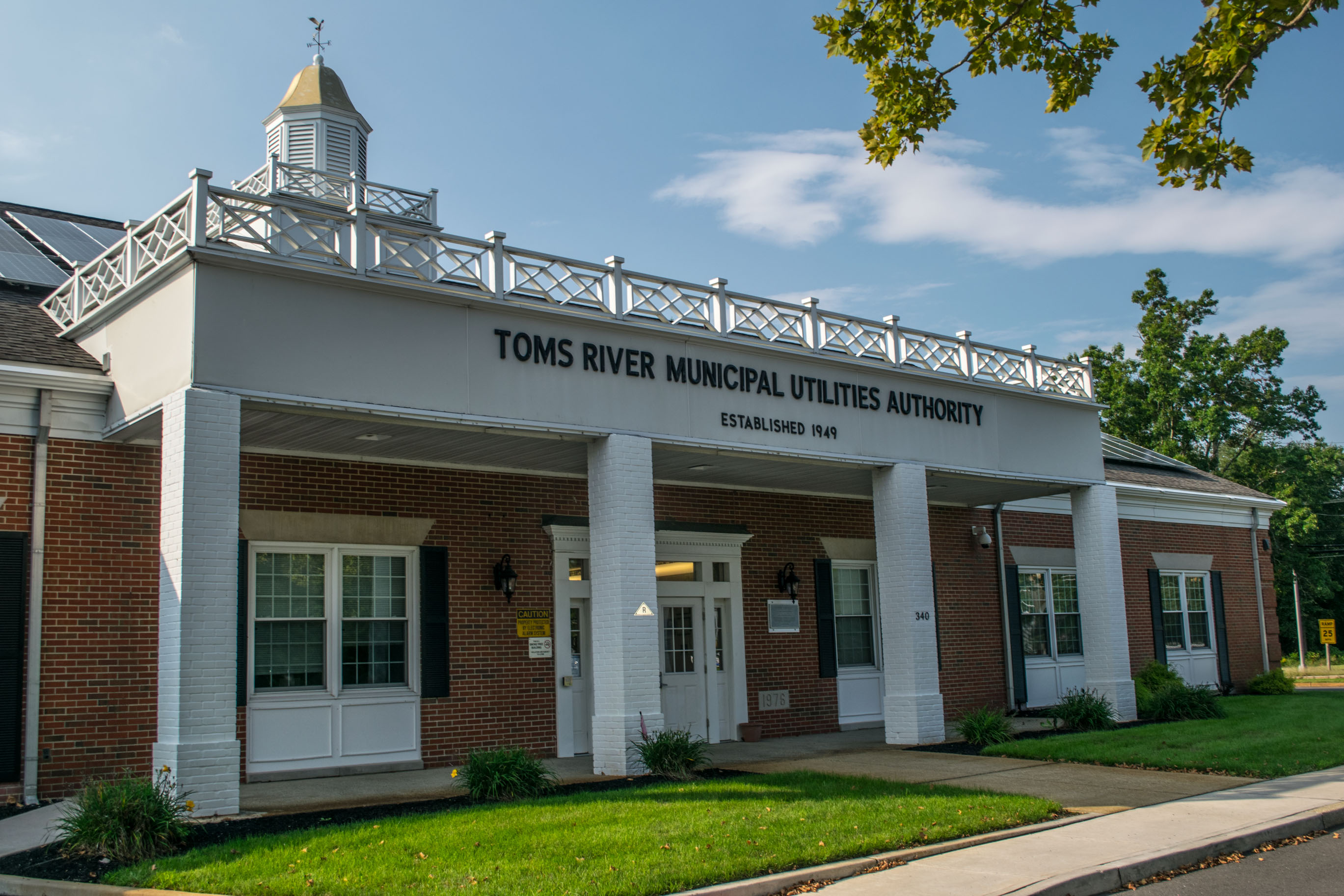
Toms River MUA Building (Photo: Daniel Nee)
The ongoing row between two factions of Republicans in Toms River Township has evolved into another duel – this time over two longstanding policies concerning a township-owned vehicle accessible to the mayor, and health benefits granted to commissioners of the Toms River Municipal Utilities Authority.
The latest debate was prompted by a measure favored by the mayor’s opponents on the council, who proposed an ordinance that would limit the mayor’s use of a township-owned vehicle to be used in town only, or when the mayor is traveling to and from official events elsewhere. Under the current ordinance, the mayor, police chief and business administrator are issued take-home vehicles that they can use in their personal capacities. The four-member majority on council signaled they wanted to prevent Mayor Daniel Rodrick from using a six-year-old township vehicle to drive to and from work as a school administrator in North Jersey.
The ordinance revision was introduced by the council’s majority in a 4-3 vote last week. In order to pass, it will require a second vote after a public hearing, however under Toms River’s form of government, the mayor has the power to veto ordinances. Though a veto can be overturned with a supermajority, the 4-3 position would not carry enough votes to do so. Additionally, questions have been raised as to whether the council has the legal authority to set administrative policies as to how legally-authorized vehicles can be used.
“I think he should have his own town vehicle, but I think he should have it at his house,” said Councilman Robert Bianchini. “I don’t think he should be taking it up and down the Garden State Parkway.”
Councilman Harry Aber, who is aligned with the mayor, disagreed.
“We already discussed this, and the mayor pretty much makes less than majority of the other mayors, and they all get their own cars, their own vehicles,” he said, adding that the use of a vehicle is part of the mayor’s compensation since he is on duty 24 hours a day.
While the mayorship is technically a full-time position, its salary is $67,936, traditionally making it necessary for mayors who are not retired to maintain regular employment in their field. Mayors dating back to at least the early 2000s have utilized township vehicles, though the extent to which they have used them on a daily basis was not clear. Officials said a 2003 vehicle used by former mayor Thomas Kelaher had about 70,000 miles on it after his term ended. Rodrick currently utilizes a six-year-old Ford SUV.
While the ordinance may appear to be destined for a veto, Rodrick said he would agree to sign it and give up using the vehicle voluntarily if the council would be willing to pass his proposal to eliminate taxpayer-funded health benefits for commissioners of the Toms River Municipal Utilities Authority. The commissioners, he said, attend a short meeting each month and are eligible for family healthcare plans that can cost as much as $40,000. In practice, some of the commissioners utilize the family plans while others utilize them individually, or waive them. MUA commissioners are appointed by the township council, with the current board split between appointees with terms that originated from various makeups of council majorities.
“I said, if you guys were willing to take away the health benefits from MUA commissioners, who only serve a half an hour a month, and get $40,000 a year – we pay for that – I would gladly give up the car, because that would save some real money,” Rodrick told council members at April 22, 2026 meeting.
Council President David Ciccozzi, an opponent of Rodrick, cast the deciding vote to introduce the ordinance.
“The mayor has every right, according to our ordinance, to have a car, use it in town, use it for official business, put gas in it for official business only,” he said. “But it’s not written in our ordinance that he can use it for personal use and work.”
The ordinance, as it currently stands, allows the three aforementioned township officials to have vehicles as part of their compensation packages, but does not formally regulate how and where they can be used. The proposed ordinance would add those regulations.
“I’m perfectly willing to give that up,” Rodrick said. “Just give me an ordinance and take it away from the MUA and I’ll sign [the ordinance].”
The vehicle ordinance is expected to be considered on second reading at the council’s next meeting May 13.


Police, Fire & Courts
Toms River Physician and Family Killed in Upstate N.Y. Plane Crash