

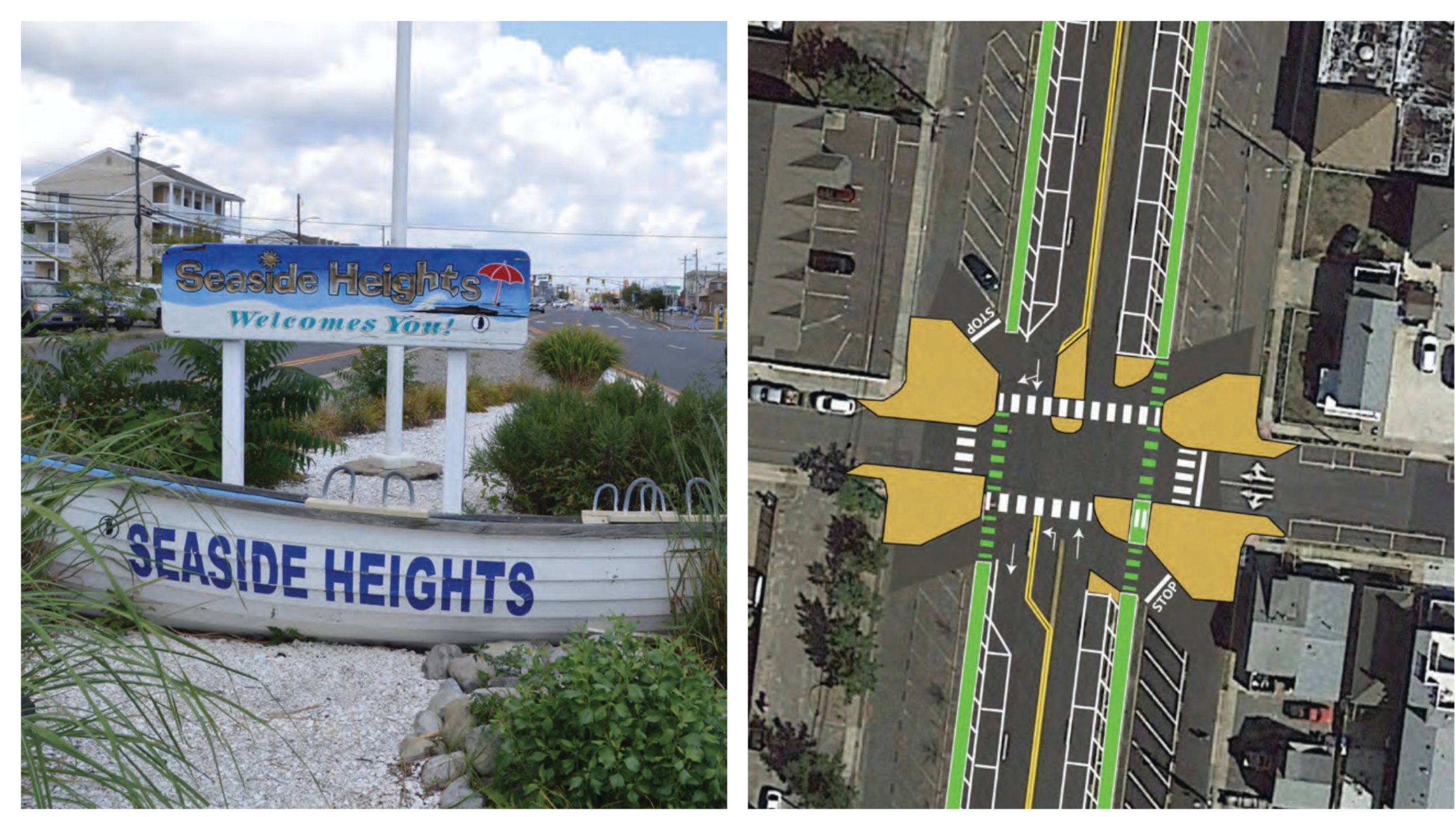
Images from a report on the redesign of Central Avenue in Seaside Heights. (Credit: NJTPA)
Seaside Heights has tapped the firm that designed Ortley Beach’s recently-approved streetscape plan to design an even more ambitious project along Central Avenue that could result in a lane realignment, the installation of bike lanes, and aesthetic improvements.
The Central Avenue project, funded by state grants, has been in the planning stages for years, held back by red tape on the county and state levels. Recently, however, officials received positive news from permitting agencies, leading them to award a contract to the firm NV5 for “construction support services.” Last week, the council formally accepted the state’s $750,000 grant to fund the engineering behind the project.
Many aspects of the plan are included in a 2023 report authored by the North Jersey Transportation Planning Authority. The 43-page document details suggestions to improve the Central Avenue corridor, including building bike lanes, reducing driving lanes and adding “road diet” measures to calm traffic, and improving sight lines and limiting the distance pedestrians must walk to cross the roadway.
“A road diet, sidewalk improvements, bicycle infrastructure, and high-quality pedestrian amenities could greatly improve the walkability and bikeability of the area while encouraging more people to walk and bicycle along the corridor,” the report said.
After years of delays, Mayor Anthony Vaz said he is confident the project will start to move more quickly toward development.
“At this time, I feel more confident than ever that something is going to be done sooner rather than later,” he said. “We’ve had the money for a few years but we couldn’t use it because of a few problems in the way.”
The final proposal by NV5 will ultimately come to the borough council before it can be bid out for potential construction.
“The design is starting now,” said Vaz. “We have our proposal, and now they will come and do their thing.”

Images from a report on the redesign of Central Avenue in Seaside Heights. (Credit: NJTPA)

Images from a report on the redesign of Central Avenue in Seaside Heights. (Credit: NJTPA)
The state’s report said eliminating unmarked crosswalks, uneven pavement and a smattering of differently-designed driveway ramps and curb cuts would improve safety from the get-go, before aesthetic improvements are even accounted-for. The study found that Central Avenue has 11 intersections along its main corridor, three of which are signalized, but many of which do not have crosswalks. The service roads that run alongside Central in either direction are prone to change from street-to-street, another decades-old design that engineers recommend should be made uniform.
Improvements could include stenciling the road’s 25 m.p.h. speed limit on the pavement, creating a 7-foot bicycle lane, and removing the four-lane setup from the corridor. The four-lane setup, the report found, would be replaced with one lane running in each direction, with the excess space used to create the bike lane and dedicated left turn lanes rather than having left-turning traffic block one of the two through-lanes. The turning lane would be separated from the main lanes by an 8-foot median to keep traffic from bunching up. In some cases, the service roads on either side of Central would be closed to through traffic, directing motorists to the main road in order to avoid collisions with other vehicles, pedestrians or bicycles.
The bicycle lanes are among the most-requested aspects of the project, with residents frequently asking for them to be included in road designs. The other improvements will work to freshen the look of Central Avenue.
“You’ll have bike lanes, new lighting, picturesque flowers and trees,” Vaz said.
Previously, officials have said the current trajectory suggests work would likely begin in 2027, however it potentially could kick off sooner should the design meet both local and state visions for the project.




Seaside Heights & Seaside Park
Seaside Heights Bursts Onto Arts Scene With ‘Gallery 619’ In the Heart of Town


Boating & Fishing
Seastreak Ferry Service to Point Pleasant Beach Nixed After Council Vote


Shore Environment
Waves Wallop Ortley Beach, Ocean Roars As ‘Erin’ Remains Offshore


