

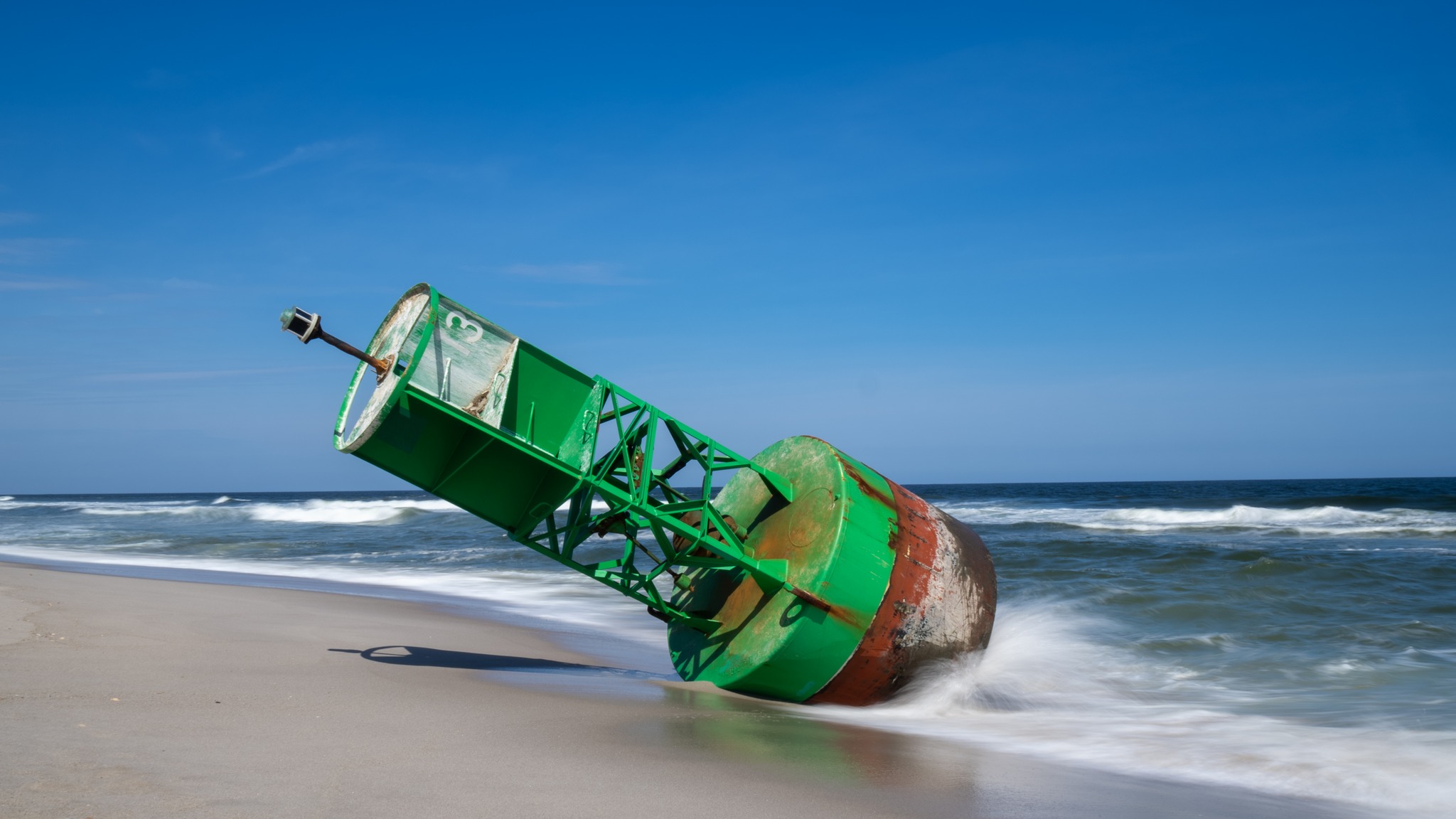
A green “13” buoy marker washes up in Seaside Heights, N.J., April 2026. (Credit: John Astrab/ Facebook)
A massive, green pillar buoy washed up on the Seaside Heights oceanfront last weekend, prompting a buzz on social media and questions about where it might have come from and how it will be removed. The buoy, marked with number “13,” came ashore along the north end of town sometime on April 10 and has remained in place ever since.
Where Did It Come From?
While there have not been any official statements from the U.S. Coast Guard about the buoy’s origins, research indicates that it is likely a marker that broke its anchor nearly 80 nautical miles away and drifted northward. While there is a green “13” marker in the channel that connects Barnegat Bay to Barnegat Inlet, it is much smaller than the one that washed up recently, and resides inside the bay itself, surrounded by the shoals near Barnegat Lighthouse.

A green “13” buoy marker washes up in Seaside Heights, N.J., April 2026. (Credit: Diane Il Grande)
There are two potential culprits – including one in the approach to Delaware Bay with a history of breaking free, earning the nickname of “Unlucky 13.” It last broke free in 2019, when it ended up embedded on the shore in Delaware. The buoy is situated on the port side of the channel that leads from the Atlantic Ocean to the ports within the Delaware Bay region. Assuming “Unlucky 13” has lived up to its history once again, jurisdiction resides with the U.S. Coast Guard’s Sector Delaware Bay, whose authority spans the ports of Philadelphia, out to the Atlantic Ocean, and northward to Shark River Inlet.
Another possibility, which has been referenced by some local officials, is a green “13” buoy that marks the Fire Island Inlet channel on the south shore of Long Island.
What Happens Next?
The removal of buoys largely depends on their size. In some cases, they can be lifted with modified towtrucks onto the flatbeds and hauled away via road. The buoy in question, however, would not fit the bill – literally – for such a removal effort. After the 2019 breakaway incident, “Unlucky 13” was plucked out of the water by a crane that was attached to a barge. It was then floated to a U.S. Coast Guard facility.
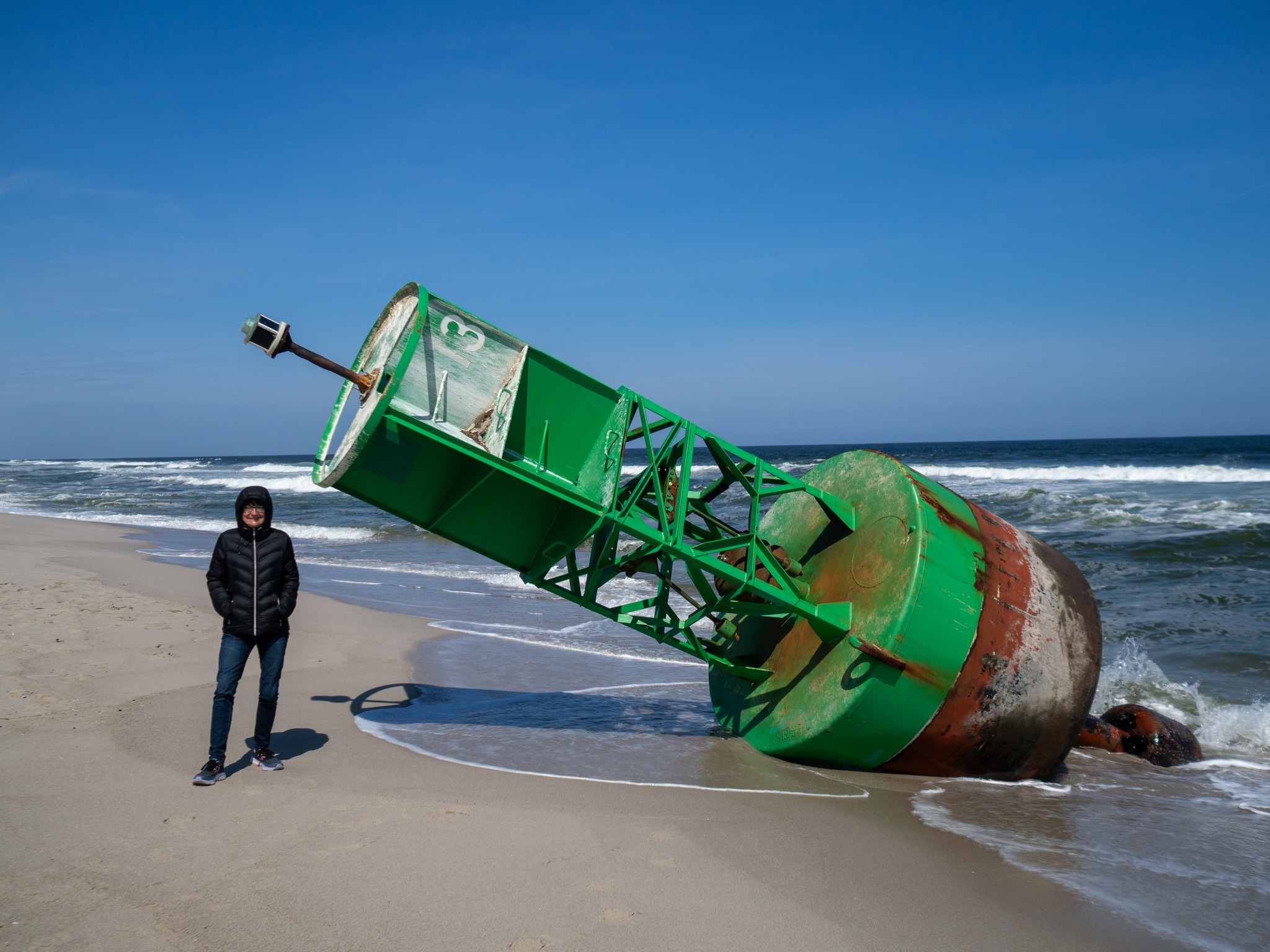
A green “13” buoy marker washes up in Seaside Heights, N.J., April 2026. (Credit: John Astrab/ Facebook)
The Seaside Heights case – a massive buoy propped up against the surf zone – will likely call for an even more unique removal strategy, said Borough Administrator Christopher Vaz. In this case, a helicopter with heavy lift capability will likely have to drop a winch or sling and haul it through the air to a place where it will either be disposed-of or repaired.
“We’ve been advised that the USCG will likely fly it out,” said Vaz. “But as of the day we reported it, there has been no additional update.”
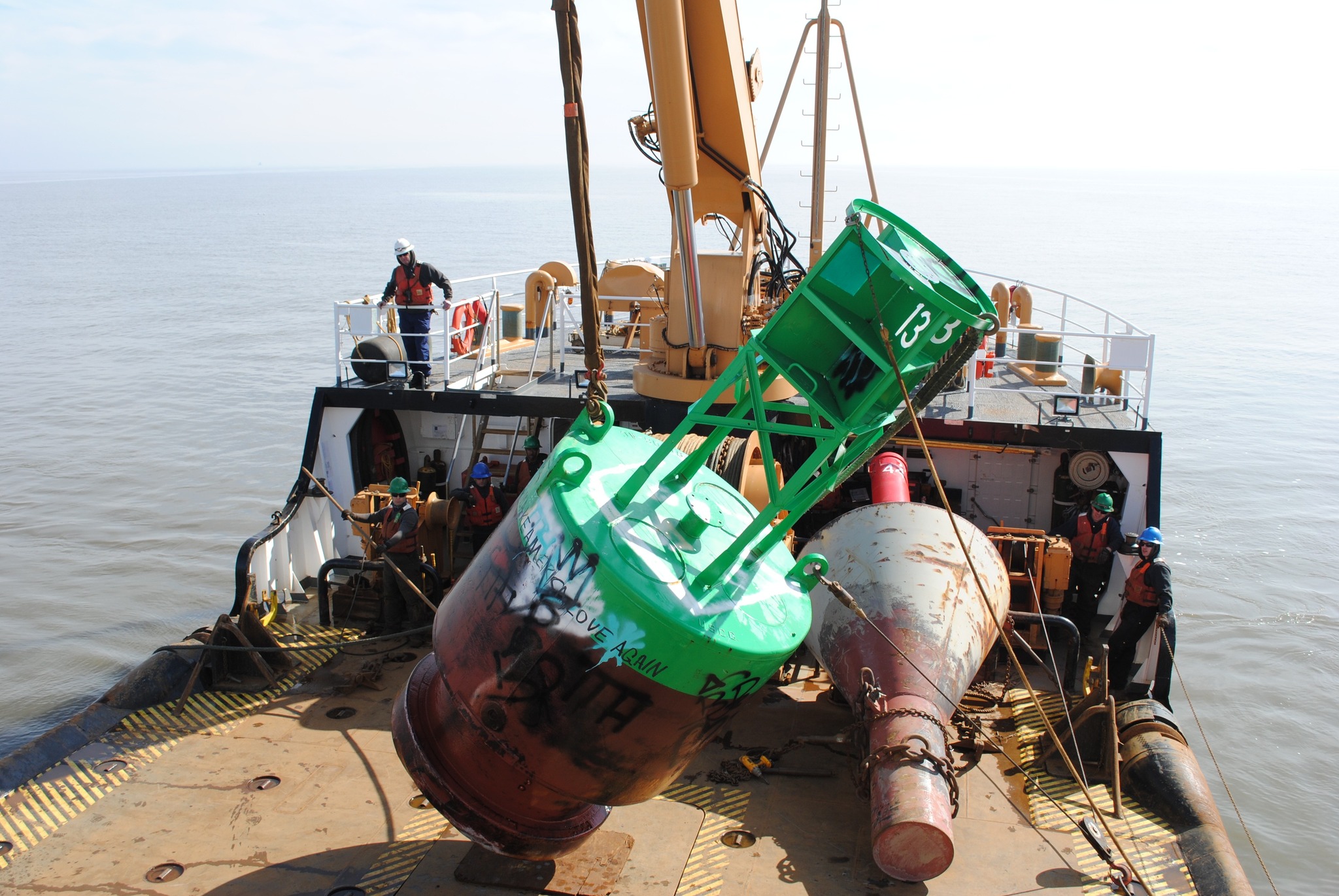
“Unlucky 13” is lifted from a beach in Delaware in 2019. (Photo: USCG)
There are three helicopters that have been used for the removal of buoys in the past – two U.S. Coast Guard platforms and one borrowed from the U.S. Army. Lighter buoys can be “rescued” using the MH-65 Dolphin, a variant of the Eurocopter AS365 that is normally used for search-and-rescue operations. The closest MH-65s are located at Coast Guard Air Station Atlantic City. The Coast Guard also operates MH-60 Jayhawk helicopters – a USCG variant of the Army’s Black Hawk – that are occasionally utilized for medium lift operations. But for large buoys like the one that has washed up in Seaside Heights that weigh between 12,000 and 14,000 pounds, the Coast Guard coordinates with the U.S. Army to remove them with the tandem-rotor CH-47 Chinook which is purpose-built for heavy lift capacity via sling lift.
Shorebeat will report back when the wayward navigational aid is removed.



Seaside Heights & Seaside Park
Star-Studded Cold War Spy Thriller To Be Filmed in Seaside Park in July


Seaside Heights & Seaside Park
Hovnanian Development in Seaside Heights Takes Shape, Sets Pricing


Shore Environment
Waves Wallop Ortley Beach, Ocean Roars As ‘Erin’ Remains Offshore


