A rendering of the Meridia at Toms River complex in its six-story iteration. (Photo: Shorebeat)
A court in Ocean County has thrown out the repeal of a plan that would allow for the redevelopment of a parcel of land downtown that once housed a derelict motel and is now vacant – the same property that has been the source of controversy for years over the future of the downtown sector’s layout. (A copy of the ruling is embedded beneath this story.)
Superior Court Judge Sean D. Gertner ruled the ordinances passed Dec. 18, 2024 repealing what had been known as the Downtown Core Redevelopment Plan, Robbins Parkway Redevelopment Plan and Waterfront Redevelopment Plan, were done so improperly. The property, near the corner of Water and Irons streets, had once been home to the Red Carpet Inn, a notorious trouble spot for police, before it was purchased by the township and razed in 2019. The site was then proposed to become the home of Meridia Toms River, first billed as a pair of 10 story towers with a maximum height of 150-feet. It was pared down to two, six-story towers after a public outcry, with the developer, Capodagli Group, promising the 281 apartments that would be contained within the buildings would be mated to a public amphitheater, boardwalk along the Toms River, shops and restaurants, plus a parking area.
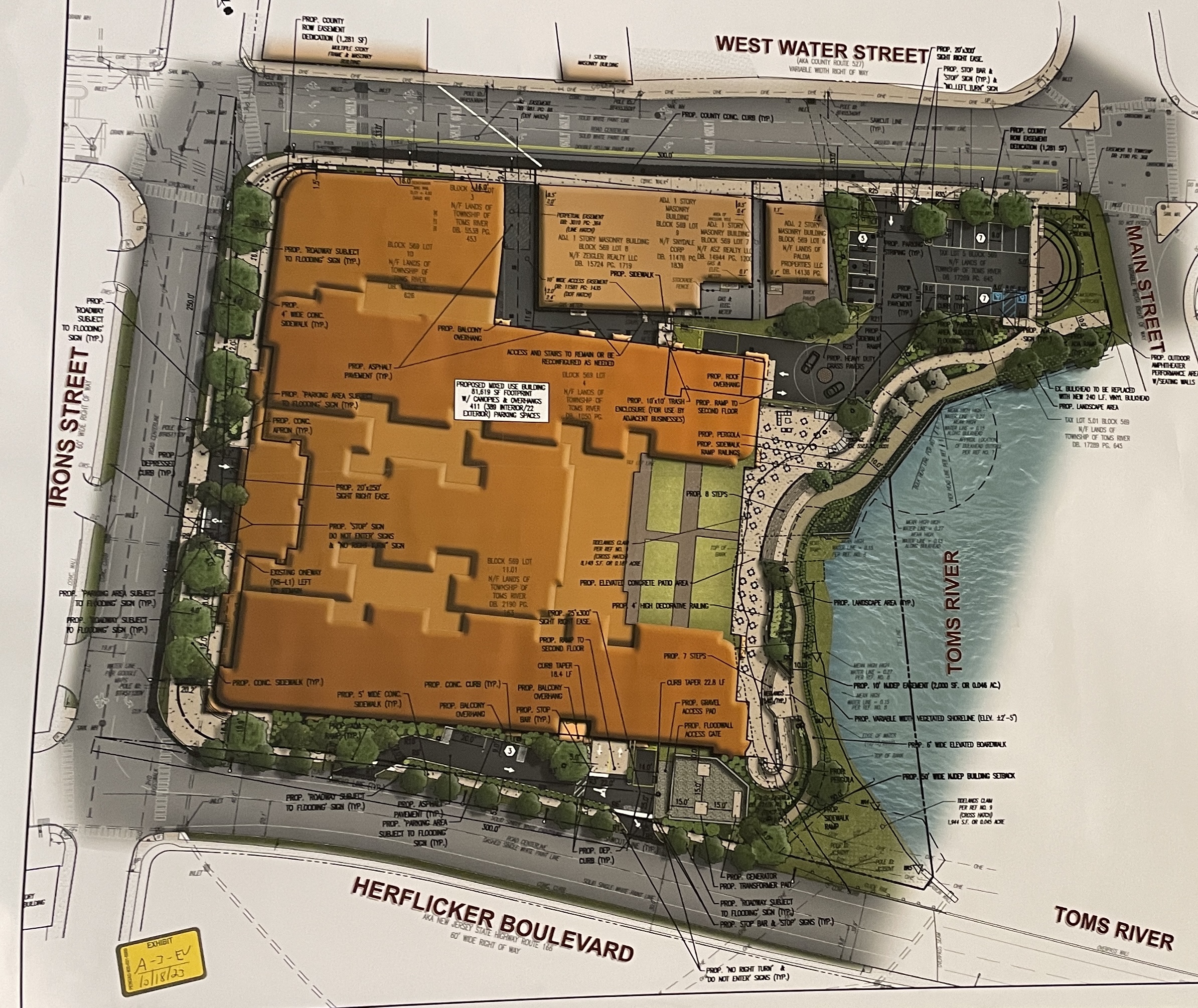
A rendering of the Meridia at Toms River complex in its six-story iteration. (Photo: Shorebeat)
The redevelopment plan was favored by the township’s business community but opposed by some residents who believed the development was too dense and too tall. Mayor Daniel Rodrick led the charge in 2023, and ultimately defeated incumbent Republican Mayor Maurice “Mo” Hill in the party’s primary and Democrat Ben Giovine in the general election. Rodrick took office in January 2024 and almost immediately began working with allies on the township council to roll back the redevelopment plan, and eventually repealing its enabling ordinance.
Capodagli filed multiple lawsuits in response – one that challenged the validity of the repeal ordinance, and the other accusing Rodrick of purposely dragging his feet on approval to induce the company to miss deadlines. The ruling announced this week concerns only the repeal ordinance, which was tossed by Gertner on technical grounds. Gerner found that two parties – former Councilman Justin Lamb and former planning board member and assistant township attorney Peter Pascarella – voted on the matter when they had conflicts of interest.
The court ruled Lamb should have recused himself from the vote because he leased office space near the redevelopment zone from his late father in order to run a law practice. While Lamb’s vote, ironically, would have gone against his father’s financial advantage as a property owner, the mere appearance of a conflict was enough to invalidate the vote, Gertner ruled.
“While there is no proof of fraud or improper motive on the part of the councilman, a perceived conflict of interest is as harmful to the public’s confidence in its representatives as the actual existence of such a conflict,” the decision stated, adding that a “hotly contested” ordinance heightens raises perceptions.
Pascarella was not a member of the council, but was a member of the township’s planning board when it reviewed the repeal ordinance and recommended it for approval. At the same time, Pascarella was serving as an assistant township attorney, which the court likewise ruled should have precluded him from voting on the measure since he provided legal advice on it to the township. Pascarella, Gertner ruled, should not have rendered an opinion on the matter.
“Mr. Pascarella did more than confess his opinions about it; he voted on it,” the judge ruled.
Gertner’s decision also touched on public notification requirements under the state’s Municipal Land Use Law, commonly known by its acronym “the MLUL.” Normally, municipal governments can repeal ordinance in the usual fashion – by placing the matter on an agenda, introducing it, then holding a public hearing and adopting it at a future meeting. Toms River’s council did so, but Gertner said that the subject matter of the ordinance meant that certain portions of the MLUL had to be followed as well. Specifically, he ruled, a separate legal notice should have been provided to Capodagli about the zoning change, which constituted an additional requirement. That additional requirement was not met.
Gertner ruled that since the ordinance was invalidated, the court did not need to rule on a number of other charges within the developer’s lawsuit. But while the repeal and zoning ordinances have been overturned, the ramifications will likely lead to more litigation rather than construction crews lining up to build 281 apartments.
Rodrick issued a statement indicating the decision would not be immediately appealed, but the township would follow the judge’s instructions on a new repeal measure.
“The township will immediately begin the process of repealing the plan again, and we will follow the judge’s recommendations during the repeal,” Rodrick said. “Residents do not want a city of 150 foot tall buildings downtown.”
Capodagli’s attorney, Steven Mlenak, said in a statement calling the ruling a “total victory” for his client.
“The court’s decision confirms that the township’s actions were legally unsupportable and that taxpayer money was wasted pursuing an ill-conceived political agenda instead of serving the public interest,” he wrote.
The statement said the case will now proceed with additional claims brought by Meridia seeking monetary damages against the township “for its illegal actions.” Capodagli’s separate lawsuit challenging the termination of the company’s downtown redevelopment rights remains pending.
“It is time for the council to recognize that Mayor Daniel Rodrick’s actions do not reflect the best interests of the township or its taxpayers,” said Dennis Liloia, General Counsel for Meridia. “Continuing down this path only guarantees more wasted public money.”
Rodrick said that his mayoral election speaks to the will of the voters, and their displeasure with dense development in the downtown district.
“I want to reassure residents that nothing can be built using the zoning in that plan without an agreement with the mayor, and I will not allow high-rises downtown,” he stressed.
~
[scribd id=1004679135 key=key-fwgXkGT08lyVWOqhdbew mode=scroll]

Police, Fire & Courts
Toms River Physician and Family Killed in Upstate N.Y. Plane Crash