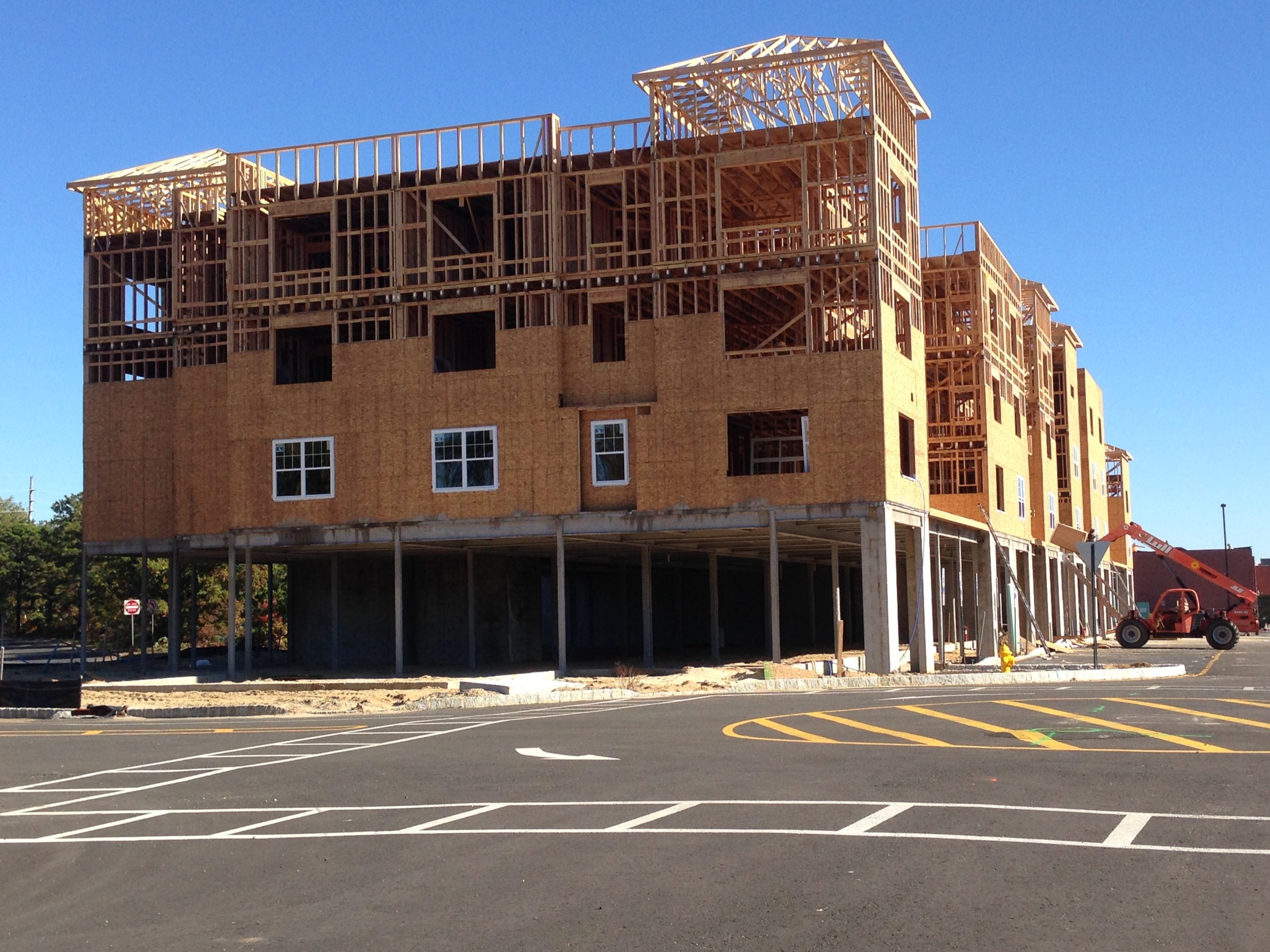
A condominium under construction in Toms River. (Photo: Daniel Nee)
Toms River Township has asked a judge to grant an extension of time to adopt ordinances that would effectuate an affordable housing settlement after disagreements between the mayor and council members boiled over last week, culminating in a confusing vote that failed to gain a majority required to adopt the measures. The state legislature had set a deadline of March 15 for towns to adopt affordable housing plans with no clear mechanism to request an extension, placing Toms River in uncharted legal waters with no indication the impasse between officials would resolve itself following a raucous council meeting last week.
Pursuant to the state’s controversial Mt. Laurel doctrine, Toms River was ordered to provide 1,700 additional units of designated affordable housing when Trenton released figures last year. Generally speaking, the 1,700 units would have been provided at a 20 percent ratio to market-rate units, meaning that more than 8,000 units would have to be built. The township put forth its own calculations opposing the state’s data, but an activist group, the Fair Share Housing Center, challenged the township’s findings. Fair Share Housing Center, over the past year, challenged the findings of near every municipality in the entire state, filing hundreds of lawsuits and effectively forcing settlements from the communities.
As part of Toms River’s settlement, approved last year, the township agreed to create 183 new housing units, while placing deed restrictions on a number of other properties – including the Hope’s Crossing development – that would keep them designated as affordable housing for another 30 years. The controversy developed due to the fact that the township required a “back up” plan should the Hope’s Crossing development owner refuse to accept the deed restrictions. The backup property was the swath of vacant land purchased by the township for $10 million under the administration of former Mayor Maurice “Mo” Hill. While the land was purchased by the township in 2016, it was never designated as open space – simply publicly-owned land – meaning it theoretically could be sold for development in the future. While there are no proposals to do so, objections were raised about the former farm property being part of the settlement, even in a backup fashion.
The settlement plan dates back from June 2025 and was approved by the court – and the Fair Share Housing Center – in December, along with similar settlements reached by hundreds of other municipalities. The council, however, was required to pass ordinances to effectuate that settlement by updating the township’s affordable housing plan and placing an overlay zone on top of other lands where affordable housing could be built in the future.
A group of four council members opposed to Rodrick – Robert Bianchini, Thomas Nivison, David Ciccozzi, and Clint Bradley – either abstained from voting on those ordinances or voted them down. Rodrick’s allies on the council, Craig Coleman, Lynn O’Toole and Harry Aber, voted in favor of the ordinances. The group said they were responding to concerns from residents of the Lake Ridge development, which is located near portions of the overlay zone. They also said some residents within a 200-foot radius of the zone may not have received legal notices about the ordinance, though this allegation was made by a resident and it was not clear what methodology was utilized in his distance calculations.
Rodrick said the failure of the council to adopt the measures could expose the town to so-called “builder’s remedy” lawsuits, in which developers could intervene, claim the township has not met its affordable housing obligation, and seek to enforce the original 1,700 unit determination.
“This is not a scare tactic,” said Rodrick, in an op-ed column sent to local media outlets this week. “This is the law — and it has devastated other New Jersey communities that failed to act in time.”
“I honestly don’t know” what the court will do with the extension request, Rodrick added, “But I will not sugarcoat the situation — it is serious, and the Council’s vote is directly responsible for putting us here.”
Shorebeat sent several e-mails to Council President David Ciccozzi requesting comment on the council majority’s intention moving forward, but did not receive a reply.
“The residents of Toms River deserve leaders who put people before developers,” said Rodrick. “That is exactly what I intend to keep doing.”


Police, Fire & Courts
Toms River Physician and Family Killed in Upstate N.Y. Plane Crash