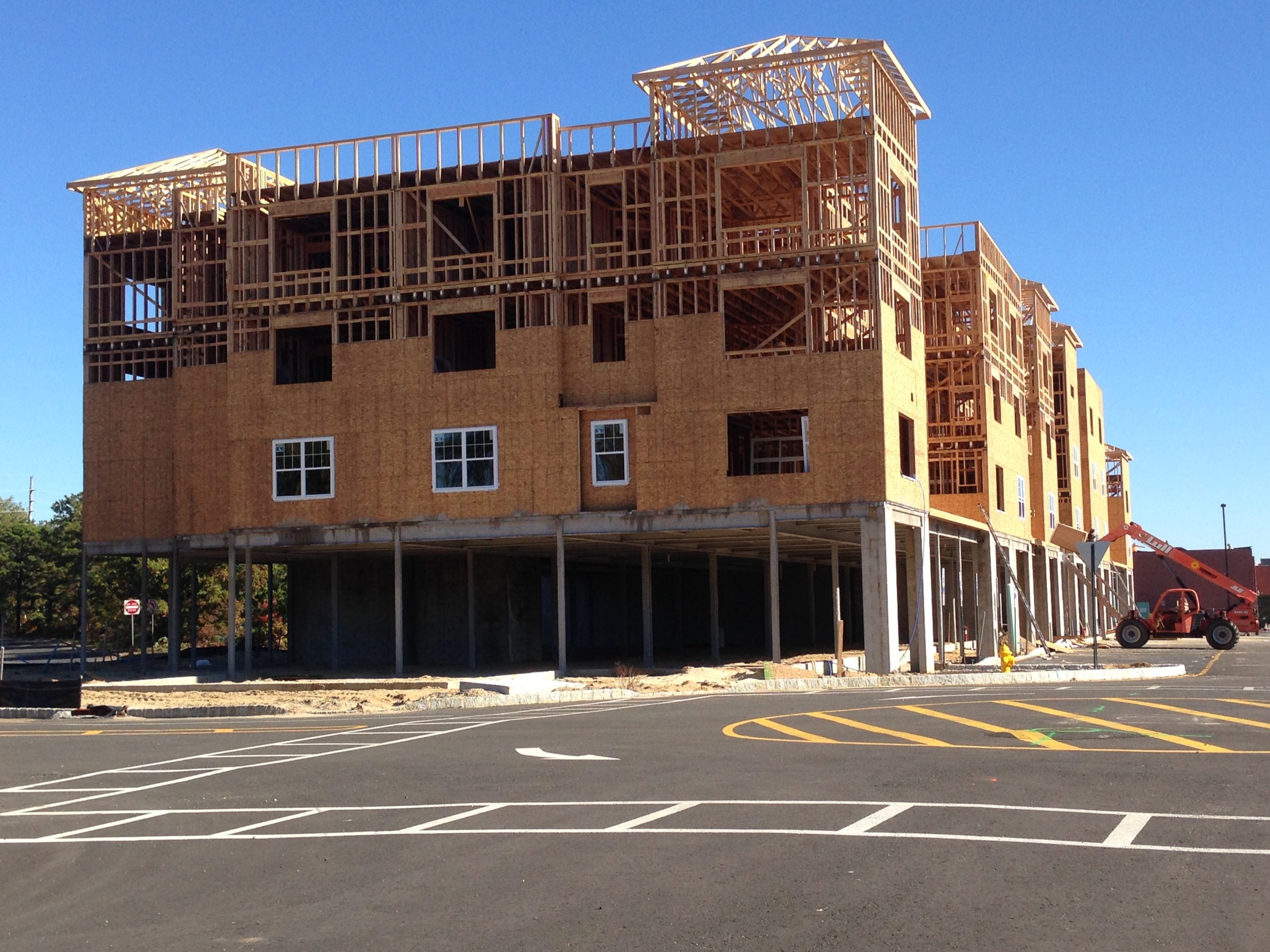
A condominium under construction in Toms River. (Photo: Daniel Nee)
The Toms River Township council on Wednesday night voted to approve an ordinance establishing a potential zone for affordable housing, one day before a judge ruled the township’s immunity from so-called builder’s remedy lawsuits could end.
Toms River was ordered by the state in 2025 to provide 1,700 additional units of designated affordable housing in calculations promulgated at the time. Generally speaking, the 1,700 units would have been provided at a 20 percent ratio to market-rate units, meaning that more than 8,000 units would have to be built. The township put forth its own calculations opposing the state’s data, but the Fair Share Housing Center, an activist group that sued nearly every municipality in New Jersey, challenged the township’s findings. Eventually, the township and the activist group settled on 183 new housing units, while placing deed restrictions on a number of other properties – including the Hope’s Crossing development – that would keep them designated as affordable housing for another 30 years. The plan for the Hope’s Crossing deed restrictions, however, fell apart, forcing officials to consider an alternative.
The backup property was identified as the swath of vacant land purchased by the township for $10 million under the administration of former Mayor Maurice “Mo” Hill near Riverwood Drive, roughly adjacent to the Lake Ridge community. While the land was purchased by the township in 2016, it was never formally designated as open space – simply publicly-owned land – meaning it theoretically could be sold for development in the future. While there are no proposals to do so, objections were raised about the former farm property being part of the settlement. The led to a rift between the mayor and four members of the township council who voted against the alternative plan before a state-imposed deadline. The township, after the vote, went back to court to ask for an extension while negotiations could take place between the mayor and council majority, which culminated in Superior Court Judge Sean D. Gertner ruling that the council must pass a substantive ordinance by April 9, 2026 in order to retain its immunity from so-called “builder’s remedy” lawsuits, in which private developers can purchase privately-owned land to build multifamily housing projects outside of the usual zoning restrictions as long as they contain a certain number of income-restricted units.
The row between Mayor Daniel Rodrick and his four adversaries on the council – Robert Bianchini, Thomas Nivison, David Ciccozzi, and Clint Bradley – largely picked up where it left off at the last meeting, which drew national publicity after it descended into a chaotic bout of name-calling. But while the disagreements remained, Ciccozzi – the council president – took a more calm and diplomatic approach, engaging in a civil discussion with Rodrick and the township’s legal counsel.
While no one – neither the mayor nor any council members – supported the idea of developing the Route 9 parcel, legal counsel suggested the governing body pass the ordinance designating the land as a potential affordable housing site in order to convince the judge that the township was serious in its quest to fulfill its mandated affordable housing load from Trenton. Rodrick said that the township was continuing to seek alternatives to the publicly-owned property. The council discussed the matter in a closed session that lasted about 45 minutes before a vote was taken.
“We’re looking for alternatives at the moment,” said Rodrick. “We have been looking for a different location and we still haven’t settled on one. That was what much of the backroom discussion pertained to.”
Though the 10 acres of former farmland was purportedly preserved for open space purposes, it was never legally designated as such, nor was it ever added to the ROSI, short for “Recreation and Open Space Inventory,” a document that makes a formal open space declaration to the state. Legally, the parcel remained an undeveloped lot that was simply purchased by the township.
Rodrick said the fact that the land is publicly-owned would provide the township time to work out alternatives, and would give the council final say on what – if anything – would ever be developed there, versus a designation of a private property where a builder could force its will.
“This council would have a full determination as to who, what, how or if the property were ever developed,” said Rodrick. “If you designated property that was not our property, someone could just come in and build. For this property, the council would have to vote at many different stages.”
Bianchini said he would still vote ‘no’ on the measure, stating that there were other resolutions on the agenda that would signal to the judge that the township was moving forward in its efforts to effectuate the settlement.
“It’s on Route 9, it’s township property, and my phone blew up everyday when they heard it was township property,” he said. “I’m not going to [vote to] build on township property. We have too much congestion up there. I’m voting no, because I don’t want no more building on township property.”
Bradley also voted no, while Nivison abstained from voting. Council members Lynne O’Toole, Harry Aber and Craig Coleman voted in favor of the ordinance, leaving Ciccozzi with the key vote. He ultimately voted ‘yes.’
“It’s only ten acres, and down the road, a future council and mayor can bury this forever,” said Ciccozzi. “I don’t want something to happen tomorrow with the judge in court. In my opinion, this will never see the light of day, so I’m voting yes.”
In addition to the ordinance designating the Route 9 parcel for affordable housing, the council passed resolutions reserving 42 units of affordable housing at the Jamestowne Village complex, another four units at 2008 Route 37 by allowing the building owner to construct a second floor, and allowing the Hooper-Caudina Redevelopment parcel to include six units by raising the allowed density from from 10 to 18 dwelling units per acre.


Police, Fire & Courts
Toms River Physician and Family Killed in Upstate N.Y. Plane Crash