
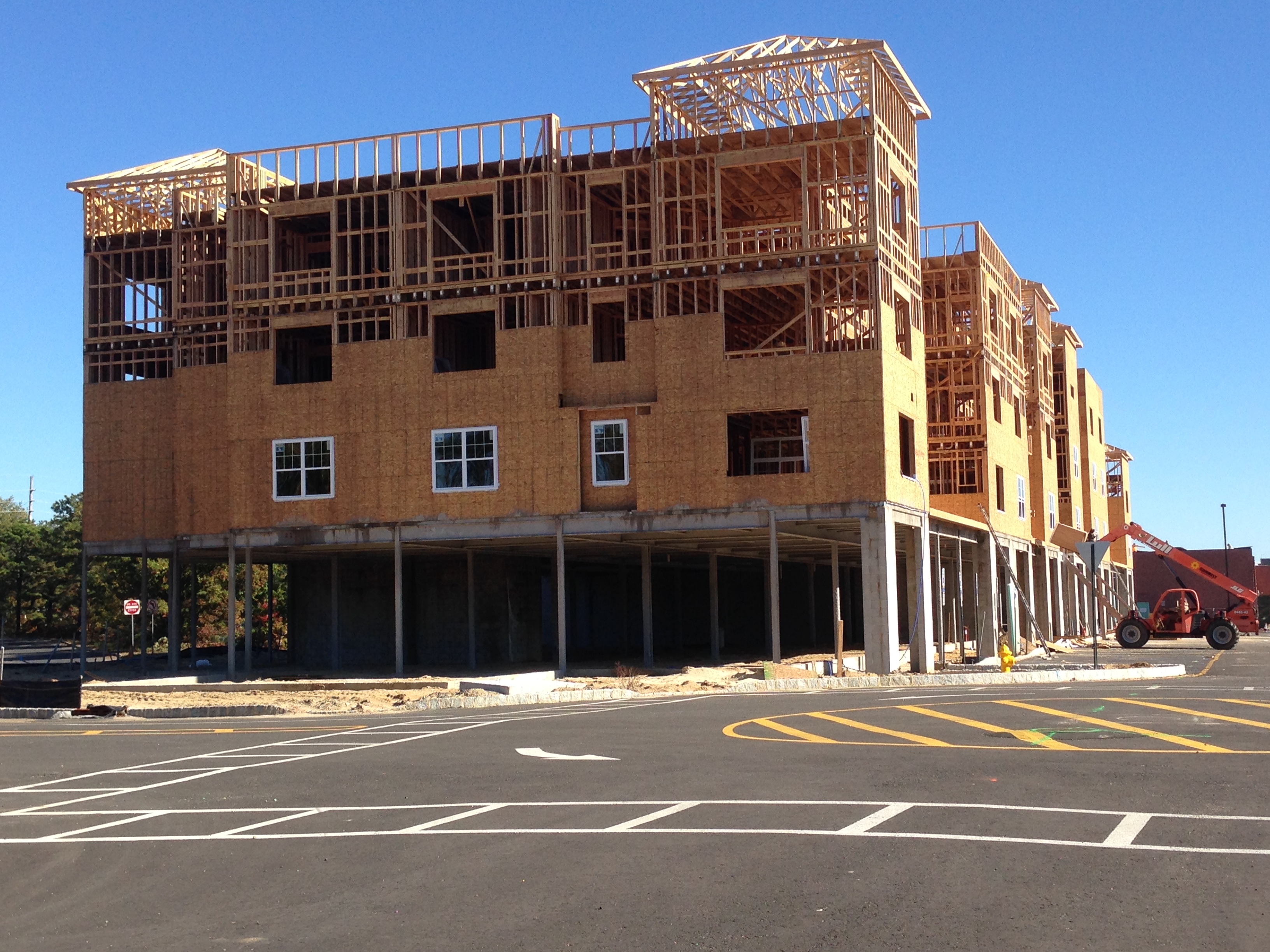
The New Visions, formerly Nobility Crest, development under construction in Brick, N.J. (Photo: Daniel Nee)
Brick Township, after being subject to litigation by the Fair Share Housing Center activist group and two developers after declaring its capacity for new affordable housing to be 29 units, has settled the action with an agreement on 322 units. That number could be subject to change based on the availability of land, or the lack thereof.
When figures were released last fall, the state found that under the controversial Mt. Laurel doctrine, Brick would be obligated to provide 360 new housing units. These units were in addition to 149 properties that the state ordered by rehabilitated since their owners would be unable to afford repairs. The township conducted a study and petitioned the court for a declaratory judgment stating that Brick only had the capacity to provide 29 units, however three parties intervened and the case made its way to mediation.
The intervening parties were the Fair Share Housing Center, an activist group that is responsible for the majority of lawsuits that oppose towns’ calculations of affordable housing need, as well as the New Jersey Builders Association – a lobbying group for the home construction industry – plus a property owner, 975 Burnt Tavern LLC, which is registered to a residential address in Jersey City. The developers’ challenges were dismissed by the court, leading the township to negotiate with the Fair Share Housing Center.
|
|
“Through mediation with the Fair Share Housing Center, the parties agreed that the township’s fourth round prospective need obligation is 322 units,” announced Councilman Vincent Minichino Tuesday night, which represents new housing units which will be required to be constructed – just nine less than the state’s original, non-binding calculation.
The 322 units must be constructed between 2025 and 2035. The township previously agreed to the state’s estimate of 149 rehabilitation units. The settlement agreement is inclusive of two conditions, however – a change in the state’s affordable housing laws or a determination that there is not enough suitable land on which to build so many units of housing. Changes to the state’s Fair Housing Act have become a major issue in the ongoing race for governor, while towns like Brick are using GIS mapping software to preserve land from being developed with new, often high-density, housing.
“We agreed that the number may be further adjusted based on the lack of vacant land as part of the planning process, which requires a consideration of realistic development opportunities based on the availability of developable land within the township,” said Minichino.
Municipalities across the state, near the end of 2024, were sent letters setting the number of affordable housing units the town would be forced to provide under what is known as “round four” of affordable housing quotas as set by the Mt. Laurel doctrine. Brick used Geographic Information System, or GIS, mapping to develop the revisions based on the amount of vacant buildable land in the township. The state’s formula for determining how many new affordable housing units must be provided is based on numerous factors, ranging from the amount of open space that could be developed into housing, to socioeconomic data.


Police, Fire & Courts
Brick Father and Son Arrested for Drug, Weapons Offenses


Police, Fire & Courts
Brick Man, 31, Charged With Selling Deadly Drugs to Overdose Victim

Local Business
Ferry From NYC Makes ‘Test Run’ to Point Pleasant Beach Dock

Boating & Fishing
Seastreak Ferry Service to Point Pleasant Beach Nixed After Council Vote


